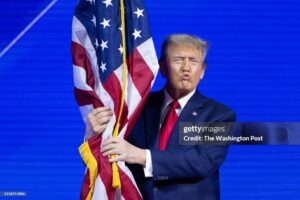
 As for me, Trump is spending the power and influence that previous generations of Americans carefully gathered. He behaves like a reckless heir who inherits a fortune built over decades—only to burn through it on short-term luxuries and fistfights with the neighbors, rather than investing in its future.
What I mean by this is not that the United States is about to collapse overnight. Rather, it is that Trump is accelerating a long-term decline that wiser leaders might have slowed or hidden. Here are the core mechanisms of this squandering.
1. The Dollar’s Privilege Is Being Eroded
America’s wealth is fundamentally based on a unique arrangement with the rest of the world. In brief, other nations trade real, tangible goods (cars, machinery, oil, electronics) for paper dollars. And crucially, much of those dollars return to the U.S. as “investments”—primarily purchases of American debt (Treasury bonds). This is often called the “exorbitant privilege” of the dollar: the U.S. gets real resources in exchange for paper it can print.
Trump’s trade wars, tariffs, and barriers to selling goods to the U.S. disrupt this delicate process. By weaponizing the dollar and trade, he encourages other countries to look for alternatives. Some are already switching to cryptocurrencies, gold, or other currencies (like the Chinese renminbi) for bilateral trade. Brazil and China, for example, have begun settling trade in their own currencies. Even India is exploring rupee-based deals with Russia. Every time a major transaction bypasses the dollar, a small crack appears in the foundation of U.S. financial power.
2. Abandoning Allies Weakens the Whole Alliance System
Trump has started pressuring his traditional allies—the UK, the European Union, Canada, Japan, and South Korea—with tariffs, threats, and public insults. He has betrayed some of them outright, for example, by undermining NATO commitments (suggesting he would not defend allies who fail to meet spending targets) or by withdrawing from the Iran nuclear deal over European objections.
The result is not immediate collapse but a slow, grinding erosion of trust. Allies will now look for other ways to protect their own security. Europe is already discussing a rapid-reaction force independent of NATO. Germany and France are talking about a European nuclear deterrent. Japan is rearming more aggressively. Others may switch their security cooperation to other local or global powers, such as China or India. Trust, once broken, takes a generation to rebuild.
3. The Decline of Influence as a Club
All of this—plus the lower trust between the U.S. and the EU, and between the U.S. and traditional partners like Canada—will lead to a decline of the very influence that Trump currently uses as a club. He is spending political capital that cannot be easily replaced.
Of course, this is not an immediate process. The United States remains the most powerful country in the world. Its military, economy, and cultural reach are unmatched. Many nations still depend on it for security, trade, and technology. But that dependence is going to decline, step-by-step, year by year. It will not be a crash. It will be a slow drift—like a once-dominant company losing market share to younger, hungrier rivals.
A Good Example: Russia Switches to China
A perfect illustration is Russia. After Trump’s first term and the full-scale invasion of Ukraine, Russia was cut off from much of the Western financial and political system. It did not collapse. Instead, it switched to the Chinese zone of influence. Today, Russia trades in renminbi, relies on Chinese electronics and cars, and coordinates foreign policy with Beijing. Russia is now, for all practical purposes, a junior partner to China. The same could happen to other countries if the U.S. continues to act as an unreliable, transactional power rather than a stable leader.
Conclusion
Trump is not destroying America. He is spending down its inheritance. Previous generations built a system of alliances, a trusted dollar, and an open trading order. He is cashing in that trust for short-term gains, bullying allies, and breaking norms. The wealth of influence is finite. And like many heirs before him, he may leave his successors a smaller, poorer estate than the one he received.
Leave a Reply